Redefinition
Taxonomy: Logical Fallacy > Informal Fallacy > Equivocation > Redefinition
Subfallacy: No-True-Scotsman Move
Example:
"…[G]un violence is the leading cause of death of the children of America―leading cause of death―not car accidents, not some form of cancer: gun violence.1"
Exposition:
To redefine a term is, of course, to assign it a new meaning. It is not necessarily fallacious to give a term a new meaning, and it is often done to produce technical terms, but there is always a danger of slipping back into using the term in its old meaning out of habit. So, one may start out reasoning with the term using its new meaning in the premisses, then fall back into using it in its familiar meaning in the conclusion, or vice versa. Thus, one may accidentally end up equivocating on the redefined term, which is why Redefinition is a subfallacy of Equivocation―see the Taxonomy, above.
There are two types of redefinition, depending on whether the redefined meaning has a wider or narrower extension than the original meaning:

- Low Redefinition2: A redefinition is called "low" when the redefined term has a wider extension than originally. For instance, if the word "bat" were redefined as "flying animal", then not only would bats be "bats", but so would many birds as well. So, the defining characteristic of a low redefinition is that the redefined term applies to some cases that the term in its original meaning does not.
Statistical studies of vague concepts require redefinition so that the extension of the concept can be counted, which opens up the way for confusion and deception. Political groups and charities often have an interest in exaggerating the prevalence of some problem so that money can be raised, and political support mobilized, to address it. For this reason, polls and other studies of social problems commissioned by interest groups frequently use low redefinition in order to pump up the numbers. Moreover, the media often play along with interest groups because alarmingly high numbers make for attention-getting stories. So, the next time you hear about such a study, find out whether it was produced by a group with an interest in exaggerating the numbers, and ask yourself whether the numbers reported are plausible. If the numbers are implausibly high, check the report for a low redefinition.
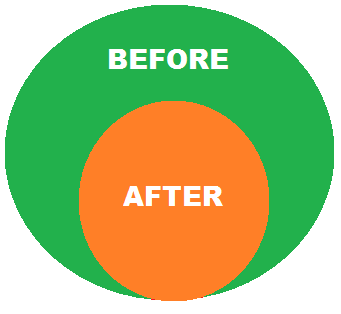
- High Redefinition2: A "high" redefinition is the opposite of a low one, that is, a redefinition is called "high" when the redefined term has a narrower extension than originally. For instance, if the word "bird" were redefined as "feathered flying animal", then flightless birds such as ostriches and penguins would no longer be "birds". So, the defining characteristic of a high redefinition is that the original term applies to some cases that the redefined term does not.
Just as low redefinition can be used to inflate the numbers in statistical studies, so high redefinition can be used to deflate them. When politicians or other advocates have a motive to downplay the size of a social problem, they may use high redefinition in order to be able to report a small number of cases.
Exposure:
Surprisingly, high and low redefinition are not mutually exclusive categories, as it's possible for a redefinition to be both high and low. This happens when the redefined term applies to some things that the original did not, and fails to apply to other things that the original did. For example, if we redefine "bird" as "flying animal", then bats would be "birds" (low), while flightless birds would not (high).
It's even possible for the extension of a redefined term to be disjoint from the extension of the original meaning, and this often happens when an existing word is redefined as a technical term. Fortunately, such technical terms are not likely to result in confusion because their two meanings are too different, and confusion is most likely to occur when the change of meanings is subtle.
Analysis of the Example3:
Harris' claim is only true if "children" is redefined to exclude those under the age of one year old, and to include those aged eighteen and nineteen4, who are for many purposes―such as voting―legally considered adults.
As mentioned above, politicians and activists often want to inflate or deflate a number, either to scare or reassure us as the case may be. In this case, they want to alarm us about violence committed with guns, and one way to do so is to make us think that such violence is the leading cause of death for children. However, it is clearly a redefinition of "children" to both exclude those under the age of one, and to include those eighteen or nineteen years old who are usually considered adults. Finally, most of the deaths by firearms of those in this artificial age group of 2-19 occur in the teen years. Without all of this definitional legerdemain, the leading cause of death for children 1-17 is motor vehicle accidents5.
It should be needless to say that pointing this out is not to downplay the problem of violence with guns, and it shouldn't be necessary to play definitional tricks like this to get people concerned. The problem is worrisome enough without exaggeration.
Notes:
- "Remarks by Vice President Harris During a Moderated Conversation at the U.S. Conference of Mayors 92nd Winter Meeting", The White House, 1/18/2024.
- Antony Flew, How to Think Straight (1998), Section 3.7.
- The analysis of the example is partly based on the following weblog entry: The Veep Debate, 10/4/2024.
- See the following fact checks:
- Nur Ibrahim, "Are Guns the Leading Cause of Death for Children in the US?", Snopes, 4/3/2023
- Glenn Kessler, "Is gun violence really the leading cause of death for children?", The Washington Post, 2/27/2024
- Christine Sellers, "Fact Check: Fact-Checking Biden's Claim that Guns are the Number One Killer of Children in America", Check Your Fact, 10/7/2024
- See: "What are the leading causes of death in the US?", USA Facts, 7/19/2024.
Revised: 10/8/2024