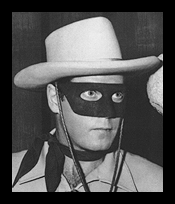
The Masked Man Fallacy
Alias: Illicit Substitution of Identicals1
Taxonomy: Logical Fallacy > Formal Fallacy > The Masked Man Fallacy2
History:
This fallacy originates with the little-known Greek philosopher Eubulides3 of the also little-known post-Socratic Megarian school of philosophy4, so-called because it was centered in the Greek city of Megara, not far from Athens. What little is known of Eubulides is that he was responsible for a group of paradoxes, including the most famous paradox of all: the liar. In addition to the liar paradox, he is also credited with two of interest to students of fallacies: the paradoxes of the heap5 and of the masked man6.
As a paradox, "the masked man" is based on a story along the following lines: suppose that you see a man but don't recognize him as your father because he's wearing a mask―perhaps it's Hallowe'en. So, you don't know who the masked man is, but you do know who your father is, yet your father and the masked man are one and the same. Therefore, you both know and don't know who your father is, which is paradoxical. The solution to the paradox is to realize that the argument just given is fallacious.
| Forms | |
|---|---|
| a = b
Ca (where C is an intensional context). Therefore, Cb. |
Ca (where C is an intensional context).
Not-Cb. Therefore, it is not the case that a = b. |
| Similar Validating Forms | |
| a = b
Ca (where C is an extensional context). Therefore, Cb. |
Ca (where C is an extensional context).
Not-Cb. Therefore, it is not the case that a = b. |
| Examples | |
| The masked man is Mr. Hyde.
The witness believes that the masked man committed the crime. Therefore, the witness believes that Mr. Hyde committed the crime. |
The witness believes that the masked man committed the crime.
The witness doesn't believe that Mr. Hyde committed the crime. Therefore, Mr. Hyde is not the masked man. |
| Counter-Examples | |
| The masked man is Mr. Hyde.
The witness testified that the masked man committed the crime. Therefore, the witness testified that Mr. Hyde committed the crime. |
The witness testified that the masked man committed the crime.
The witness did not testify that Mr. Hyde committed the crime. Therefore, Mr. Hyde is not the masked man. |
Exposition:
Substitution of Identicals7 (SI) is a familiar form of reasoning, especially in mathematics. If x is identical to y, then whatever is true of x will also be true of y, so that you can substitute x for y in any statement without changing its truth-value. Therefore, this is a validating form of argument so long as the context in which it occurs is what is called "extensional"8, but in non-extensional contexts―which are called "intensional"9―SI is non-validating.
What is an "intensional" context? Basically, it's one in which SI does not hold! This is not very helpful, but the distinction can be drawn by examples: given that Mark Twain wrote Huck Finn and that Sam Clemens was the same person as Mark Twain, then Sam Clemens wrote Huck Finn. The context "x wrote Huck Finn" is extensional, which means that we can validly substitute identicals within it. In contrast, if Joe said "Mark Twain wrote Huck Finn", it does not follow that he said "Sam Clemens wrote Huck Finn", for he may have said no such thing. A quoted context is an intensional context, as are such other contexts as:
- Propositional attitudes10: belief, desire, fear, etc. A "propositional attitude" is a context that expresses the "attitude" of a person towards a proposition. For instance, consider the proposition "Santa Claus exists". "Larry believes that Santa exists", "Curly desires that Santa exists", and "Moe fears that Santa exists", report propositional attitudes, specifically, the attitudes of Larry, Curly, and Moe towards the proposition that Santa exists.
- Modal contexts11: necessity, possibility, etc. Propositions involving modalities, such as necessity and related notions, are intensional. For example, it's true that Sam Clemens was necessarily identical to Sam Clemens. However, it is false that Sam Clemens was necessarily identical to Mark Twain, even though Sam Clemens was, in fact, identical to Mark Twain. Clemens could have chosen a different pen name, or died young, or decided not to be a writer, etc. It's the context of necessity here which makes the proposition intensional.
The Fallacy of Illicit Substitution of Identicals—or, more colorfully, "The Masked Man Fallacy"—is an application of SI within an intensional context.
Exposure:
The most familiar uses of SI are mathematical, where the contexts are always extensional. This may mislead people into thinking that SI is valid in all contexts, and may be one source of this fallacy.
Notes:
- W. Kent Wilson, "Formal Fallacy", in The Cambridge Dictionary of Philosophy (2nd edition), Robert Audi, General Editor (1999).
- Jack MacIntosh, in The Oxford Companion to Philosophy, Ted Honderich, editor, (1995).
- Eubulides' dates of birth and death appear not to be known, but he flourished in the 4th century B.C.E.
- See: David B. Robinson, "Megarians", in The Encyclopedia of Philosophy (1972), Paul Edwards, Editor in Chief.
- What is sometimes, confusingly, called "the slippery slope fallacy" is also sometimes, less confusingly, called "the fallacy of the heap" after this paradox. See the fallacies of vagueness.
- Or "The Veiled Man", see: Eduard Zeller, Outlines of the History of Greek Philosophy (13th edition, 1950), p. 124. Zeller refers to it as a fallacy, though.
- Also known as "Leibniz' Law" or "the indiscernibility of identicals", see: Simon Blackburn, The Oxford Dictionary of Philosophy (1996).
- Also called "referentially transparent", see Blackburn.
- Not "intentional", which means something else entirely. "Intensional" is also called "referentially opaque", see Blackburn.
- See Blackburn.
- See the entry for modal fallacies for more on modalities.