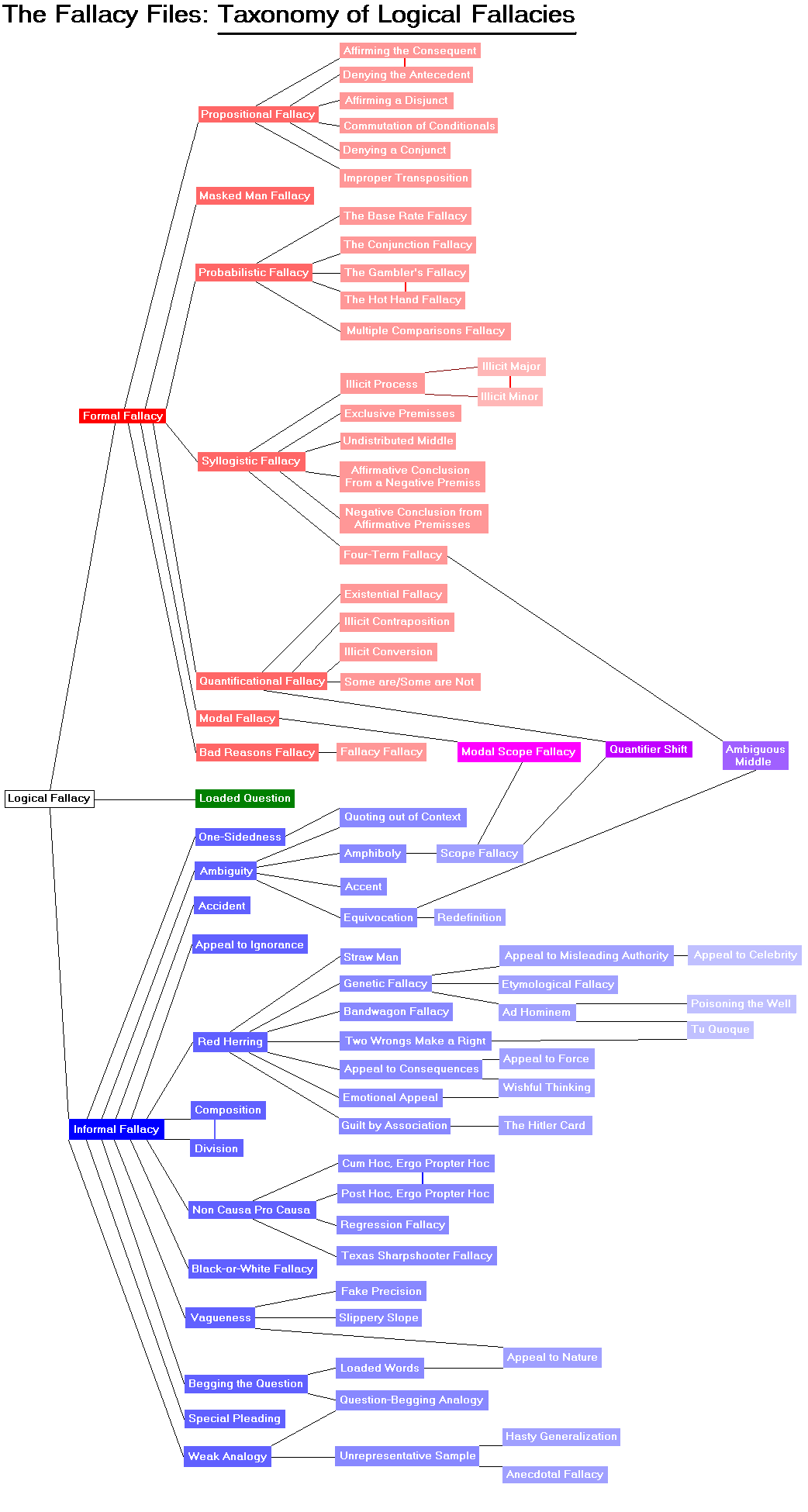
The Taxonomy of Logical Fallacies

Beginning with Aristotle, the first logician to name fallacies, most logicians who have studied fallacies have classified them into types. Aristotle classified his list of fallacies into two types:

  • Linguistic: Those which depend on language.
  • Non-linguistic: Those which do not depend on language.

Subsequent logicians have usually extended Aristotle's classification by subdividing the second, non-linguistic, category into, for instance, fallacies of relevance and fallacies of presumption. However, most such classifications have remained relatively "flat", with all fallacies on the same level, but a flat classification does not do justice to the complexity of the logical relations between different fallacies.

In recent years, some logicians have begun to make use of the notion of a subfallacy, that is, a fallacy which is a specific version of a more general fallacy. A subfallacy has whatever features the more general fallacy has, together with specific features which set it apart and make it worth naming in its own right.

The Taxonomy categorizes all of the fallacies in these files by fallacy and subfallacy. For example, instead of grouping together "fallacies of relevance", there is one most general such fallacy—namely, Red Herring—and all fallacies of relevance are subfallacies of it. Red Herring is itself a subfallacy of Informal Fallacy, which is a subfallacy of the most general logical fallacy of all: Logical Fallacy. Logical Fallacy is not shown in the Taxonomy, though it has an entry in the files, but every fallacy in the Taxonomy is a subfallacy of it. Thus, the subfallacy relationship is like a tree with a trunk―Logical Fallacy―which branches until it reaches leaves, that is, fallacies which have no subfallacies―for example, Appeal to Celebrity.

Appeal to Celebrity is a subfallacy of Appeal to Misleading Authority, which is itself a subfallacy of the Genetic Fallacy. This means that Appeal to Celebrity is a subsubfallacy of Genetic Fallacy. I have abbreviated "subsubfallacy" as "sub2fallacy", that is, "sub-squared-fallacy". Similarly, rather than writing out "subsubsubfallacy", I write "sub3fallacy". These terms are used in the Taxonomy to label the depth of the logical fallacy in the tree, that is, a fallacy listed under the heading "sub2fallacy" is actually at the third branching of the taxonomical tree. The three fallacies listed under "Fallacy" are the first branching of the tree under Logical Fallacy.

The Taxonomy is more useful than the alphabetical index for studying the logical relationships between fallacies. To understand an individual fallacy, it may be helpful to move upward in the Taxonomy via the "Type" link, in order to understand the more general fallacy of which it is a subfallacy. Also, moving downward via the "Subfallacy" link can help in understanding a general fallacy through seeing a more specific version of it. Finally, moving sideways via the "Sibling" link can help to explain the nature of a fallacy by comparing it with a similar one of the same basic type. Some individual fallacies―such as Wishful Thinking―are found in more than one spot in the Taxonomy, which is because they are subfallacies of more than one type of fallacy.

Another use for the Taxonomy is in finding a fallacy whose name you do not know, but you do know what general type of mistake you are looking for. Start with a general fallacy, and "drill down" into the Taxonomy until you find it.

FallacySubfallacySub2fallacySub3fallacySub4fallacy
Formal FallacyBad Reasons FallacyFallacy Fallacy
Fallacy of Modal LogicModal Scope Fallacy
Fallacy of Propositional LogicAffirming a Disjunct
Affirming the Consequent
Commutation of Conditionals
Denying a Conjunct
Denying the Antecedent
Improper Transposition
Fallacy of Quantificational LogicExistential Fallacy
Illicit Conversion
Quantifier Shift
Some Are/Some Are Not
Masked Man Fallacy
Probabilistic Fallacy The Base Rate Fallacy
The Conjunction Fallacy
The Gambler's Fallacy
The Hot Hand Fallacy
Syllogistic FallacyAffirmative Conclusion from a Negative Premiss
Exclusive Premisses
Four-Term FallacyAmbiguous Middle
Illicit ProcessIllicit Major
Illicit Minor
Negative Conclusion from Affirmative Premisses
Undistributed Middle
Informal FallacyAccidentAppeal to Nature
AmbiguityAccent
AmphibolyScope FallacyModal Scope Fallacy (see above)
Quantifier Shift (see above)
EquivocationAmbiguous Middle (see above)
Redefinition
Quoting Out of Context
Appeal to Ignorance
Begging the QuestionLoaded WordsAppeal to Nature (see above)
Question-Begging Analogy
Black-or-White Fallacy
Composition
Division
Non Causa Pro CausaCum Hoc, Ergo Propter Hoc
Post Hoc, Ergo Propter Hoc
The Regression Fallacy
Texas Sharpshooter Fallacy
One-Sidedness
Red HerringAppeal to ConsequencesAppeal to Force
Wishful Thinking
Bandwagon Fallacy
Emotional AppealWishful Thinking (see above)
Genetic Fallacy Argumentum ad Hominem Poisoning the Well
Tu Quoque
Appeal to Misleading AuthorityAppeal to Celebrity
Etymological Fallacy
Guilt by Association The Hitler Card
Straw Man
Two Wrongs Make a RightTu Quoque (see above)
Special Pleading
VaguenessAppeal to Nature (see above)
Fake Precision
Slippery Slope
Weak AnalogyQuestion-Begging Analogy (see above)
Unrepresentative SampleHasty Generalization
The Anecdotal Fallacy
Loaded Question

Main Menu: The Fallacy Files


gncurtis@fallacyfiles.org