Previous Month | RSS/XML | Current
WEBLOG
June 4th, 2026 (Permalink)
How to Solve Logic Puzzles with Euler Diagrams
In a couple of previous entries, I explained how to use Venn diagrams to solve certain types of logic puzzle1. In this one, I'll show how you can do so with Euler diagrams instead. I've previously explained the difference between these two types of diagram, so I won't do so again2. Let's begin with an easy example; try to solve the following puzzle with any method you please, or none at all. Here are the clues:
- Anyone's aunt is somebody's sister.
- Ants are six-legged insects.
- Nobody's sister has six legs.
Based on these three clues, what can you conclude about the relation between ants and aunts?
There are four classes mentioned in the three clues: aunts, sisters, ants, and insects. There could be a fifth class, namely, six-legged animals, but since all insects have six legs and almost all animals that have six legs are insects, let's treat insect and six-legged as the same class. Moreover, as we shall see, the clues are either A-type or E-type categorical statements. So, this puzzle is a good candidate for an Euler instead of a Venn diagram, since Venn diagrams for more than three classes are problematic, as are Euler diagrams of I-type or O-type categorical statements.
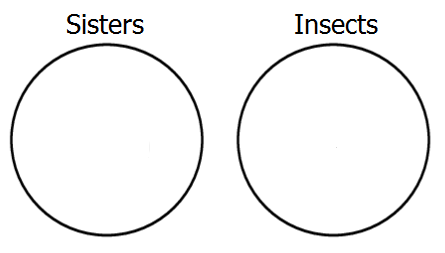
Let's start by representing the third premiss, which says that the classes of sisters and insects are disjoint, that is, it's E-type. To show this with an Euler diagram, we construct two non-overlapping circles, like so:
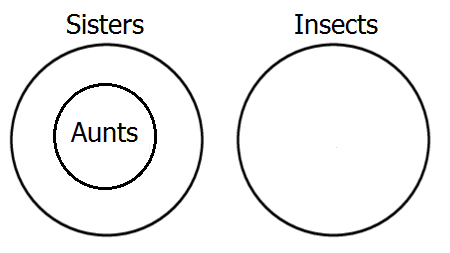
Next, represent the first premiss, which tells us that all aunts are sisters, which is A-type. To show this in the diagram, we place the circle representing aunts completely within the circle of sisters.
Finally, represent the second premiss, which says that all ants are insects―another A-type―by placing a circle for ants inside the insect circle.
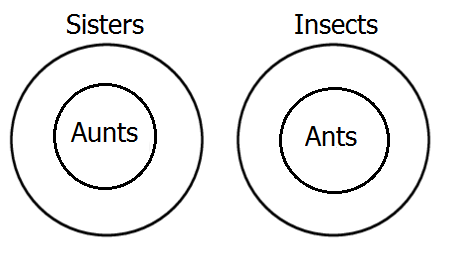
We're done diagramming! Now, we just need to look at the diagram and see what relation it shows between ants and aunts. Obviously, the diagram shows that the class of ants and the class of aunts are disjoint, in other words, no aunts are ants. I'm sure you already knew that, but it's to nice to see it proved.
The most difficult part of the puzzle was not the diagramming, but representing the clues as relations between classes. Here's a harder puzzle to practice your Euler diagramming skills on:
- Detective stories are a type of genre fiction.
- Literary snobs like only literary fiction.
- Poe's Dupin stories are the first real detective stories.
- Genre fiction is highly popular with most readers.
- Literary fiction is not popular.
Do literary snobs like Poe's stories about Dupin?
All of the clues are either A-type or E-type statements.
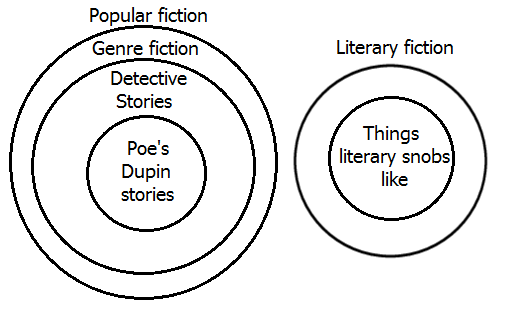
Here's an Euler diagram displaying the logical relations between the classes mentioned in the clues. As you can see, the diagram shows that literary snobs don't like Edgar Allan Poe's Dupin stories. That's why they're snobs!
Disclaimer: No sisters, aunts, ants, or other insects were harmed in the making of these puzzles, but some literary snobs may have had their feelings hurt. Sorry.
Notes:
- ↑ See: Using Venn Diagrams to Solve Puzzles, Part 1, 1/18/2017 & Part 2, 3/7/2017.
- ↑ See: Lesson in Logic 12: Two-Circle Venn Diagrams, 7/16/2016, Lesson in Logic 16: The Third Circle, 2/16/2017 & Lesson on Logic 21: Euler Diagrams, 8/20/2025.