WEBLOG
Previous Month | RSS/XML | Current | Next Month
April 22nd, 2007 (Permalink)
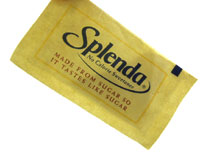
American Splenda
Readers who have been following the lessons in logic can exercise some of their new skills on the slogan of the sugar substitute Splenda:
Made from sugar so it tastes like sugar.
Q: Is this slogan an argument?
A: Yes, it is.
Q: How can you tell?
A: The word "so" is an argument indicator.
Q: What is the argument's conclusion?
A: "It (Splenda) tastes like sugar."
Q: How can you tell?
A: "So" is a conclusion indicator.
To sum up, here's the argument made by the slogan:
Premiss: Splenda is made from sugar.
Conclusion: Splenda tastes like sugar.
Q: Is this a cogent argument?
The makers of the rival sugar substitute Equal are suing the makers of Splenda for false advertising partly because of this slogan. Since I'm not a lawyer, I take no position on the legal issue of false advertising; but, as a logician, I think that the makers of Splenda are guilty of fallacious arguing.
The problem is that the phrase "made from" is ambiguous. In order for the argument made by the slogan to be cogent, Splenda must be "made from" sugar in some way that preserves the taste of sugar. For instance, one might say that a piece of candy is sweet because it is made from sugar. The sweetness of the candy comes from the sweetness of the sugar because the sugar is not chemically changed in the process of making the candy.
However, Splenda is "made from" sugar in a different way: its sweetness comes from sucralose, a chemical which can be made from sugar, that is, sucrose. However, in the chemical process that produces sucralose, the sucrose is destroyed. There is no sugar in Splenda, so its sweetness is not the result of the sweetness of sugar.
So, in order for the slogan to be cogent, Splenda would have to be made from sugar in a different way than it is made. In other words, to be cogent, its premiss must be false. In the sense in which the premiss is true, the argument is uncogent.
Apparently, Splenda is actually made using cane sugar, but sucralose can also be manufactured from such things as broccoli. However, don't expect to see "Made from broccoli so it tastes like broccoli" on its packets. Since the end result of the chemical process is sucralose, it will taste just as sweet whether it is made from sugar, beans, or onions. So, the fact―if it is a fact―that Splenda tastes like sugar is not because it is "made from" sugar.
Splenda's slogan is either a non sequitur, or its premiss is false. Is that false advertising? Maybe, maybe not, but it is fallacious advertising.
Source: Lynnley Browning, "Sweet like sugar―but it's not sugar", Boston Globe, 4/9/2007
Resource: Lessons in Logic 4: Conclusion Indicators, 4/11/2007
Update (10/7/2008):
After an undisclosed out-of-court settlement of the lawsuit, the makers of Splenda changed its slogan to: "It’s made from sugar. It tastes like sugar. But it’s not sugar." This eliminates the misleading conclusion indicator, "so", between the first and second sentences. However, the new slogan may still mislead people, because it's a convention of communication that when two statements occur close together they should have some kind of close connection. Moreover, another convention is that, just as causes precede effects, statements of causes precede statements of effects. For this reason, it's likely that many consumers will think that Splenda's being made from sugar causes it to taste like sugar. This, of course, is the same misinformation that the original slogan conveyed, though the new one is subtler and, thus, sneakier about insinuating it.
Source: Lynnley Browning, "New Salvo in Splenda Skirmish", The New York Times, 9/23/2008
April 20th, 2007 (Permalink)
The Worst of All Possible Arguments
Keung Ngai recently wrote to ask an interesting question: Can any categorical syllogism commit all of the syllogistic fallacies? The answer is no, because some of the fallacies exclude others. For instance, a syllogism which commits the fallacy of affirmative conclusion from a negative premiss cannot also commit the fallacy of negative conclusion from affirmative premisses. However, it is possible for arguments to commit more than one syllogistic fallacy. For instance:
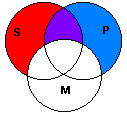
All koalas are marsupials.
All kangaroos are marsupials.
Therefore, no kangaroos are koalas.
This argument has both an undistributed middle term―"marsupials"―and a negative conclusion together with affirmative premisses. So, while it isn't possible for a syllogism to commit every fallacy, it's possible to commit more than one. This raises the question: What is the maximum number of fallacies that can be committed by a categorical syllogism?
The answer, of course, depends upon how many syllogistic fallacies one recognizes. For instance, one could get by with a general fallacy of illicit process, rather than having the two subfallacies of illicit major and minor. Let's use the list of subfallacies given in the entry for syllogistic fallacy, treating illicit major and minor as two distinct fallacies, and not counting illicit process as a separate fallacy. Furthermore, let's add the existential fallacy, which isn't listed as a type of syllogistic fallacy because it is a more general formal fallacy, but can occur in syllogisms. That makes a total of eight possible syllogistic fallacies:
- Affirmative Conclusion from a Negative Premiss
- Exclusive Premisses
- Existential Fallacy
- Four-Term Fallacy
- Illicit Major Term
- Illicit Minor Term
- Negative Conclusion from Affirmative Premisses
- Undistributed Middle Term
My challenge to you, the reader, is to devise a categorical syllogism that commits the largest number of the above fallacies. There is no prize, other than the sense of accomplishment you will feel from having devised the worst argument in the history of the world―or, at least, the worst syllogism―but what more could you need?
April 14th, 2007 (Permalink)
Q&A
Q: My wife and I entered into the difficult debate of whether to vaccinate our child. During my research, I ran into the below excerpt from a book and thought that it contained a fallacy, but I'm wondering if I'm right or just too cynical.Smallpox was the scourge of mankind in 1717 when Zabdiel Boylston developed an effective but hazardous method of protection. He called it inoculation. He injected a small amount of infected material directly from smallpox patients into uninfected patients.It was reasonably effective. During previous epidemics of smallpox, one in seven of those infected died. Only one in forty-one of those Boylston inoculated died. Boylston did not lack volunteers for this risky procedure because fear of the epidemic drove people to him. Boylston's medical colleagues, however, strongly opposed his revolutionary practice. They made a great deal of the one of his forty-one patients who died, ignoring the extraordinary improvement in mortality the other forty represented.
They accused Boylston of violating two of the ancient injunctions of Hippocrates, whose teachings had guided medical ethics since antiquity: "Above all do no harm to anyone nor give advice which may cause his death." Boylston persevered in his treatment because he understood the relative risks of not being inoculated (at epidemic's end, 844 of 5,759 people, or 14.6 percent of those who developed smallpox, died) compared to the risks of being inoculated (eventually 6 of 247 people, or 2.4 percent of those he inoculated, died).
This striking reduction in the risk of death eventually exonerated Boylston and demonstrated the principle that smallpox could be prevented by human intervention, eventually leading to the almost-foolproof method of vaccination.
Source: When to Take a Risk (1987)
It seems to me that the author and Boylston argue (essentially), "2.4% of people dying is much better than 14.6% of people dying, therefore, everyone should be vaccinated." However, don't they make an error? Fourteen-point-six percent of those "who developed smallpox" died; but how many of the 247 people that volunteered for the vaccination would have ever contracted smallpox? If (hypothetically) only ten of the vaccinated sample would have naturally contracted smallpox, then only 1 or 2 of them would have died compared to the 6 that really died due to the vaccination, right?
Or, put in another way, since we don't know what the total population was, then we can't compare the smallpox deathrate of the total population compared to the vaccination deathrate of the 247 population. So, if (hypothetically) the total population was 100,000 people, then the 844 death rate would represent a less than 1% death rate for smallpox compared to the 2.4% deathrate of the vaccination.
I know that my argument does not make a case against the vaccinations, but likewise their argument does not make a case for vaccinations, right?―Anthony T.
A: It's important to get clear about what the passage is talking about before criticizing it. First of all, Boylston wasn't vaccinating people in the modern sense, since he didn't have a vaccine, but was inoculating them with small quantities of smallpox. Vaccination for smallpox was done late in the same century by Edward Jenner, who inoculated a boy with cowpox, a similar but less dangerous disease that conferred immunity to smallpox. This is why the word "vaccinate" comes from the Latin word "vacca" for cow. Vaccinations today are done using weakened or altered versions of a virus. So, whether it would have been a good idea for someone to have undergone Boylston's procedure is a separate issue from vaccination today.
Now, let's turn to the historical question of whether it would have been a good idea to be inoculated by Boylston in 18th century Boston. You're right that you can't decide this issue simply by comparing the death rates of inoculation and smallpox. Rather, you need to know the likelihood of contracting smallpox. If it were as low as in your examples, then it would be riskier to get inoculated than to just take the chance of catching the disease. So, what was the risk of getting smallpox in the Boston of Boylston's time?
According to the Source linked to below, the population of Boston during the epidemic of 1721 was approximately 12,000, of which half contracted smallpox. The death rate was 14%, so around 840 people died. Suppose that the entire population of Boston had been inoculated. Given that the death rate from inoculation was about 2%, this means that 240 people would have died. So, approximately 600 lives would have been saved by inoculating the entire city.
The passage that you quoted is misleading in that it does not mention the infection rate of smallpox, which is needed to evaluate Boylston's procedure. While interesting in its own right, what happened 300 years ago has no bearing on whether it's a good idea to have your child vaccinated.
Source: Stefan Riedel, "Edward Jenner and the History of Smallpox and Vaccination", Baylor University Medical Center Proceedings, 1/2005
April 11th, 2007 (Permalink)
Lessons in Logic 4: Conclusion Indicators
Having recognized that a passage contains an argument, the next skill that a logician requires is the ability to analyze its structure. By "structure", I mean identifying which of the argument's statements are premisses and which is the conclusion. Assuming that the passage contains a single argument, identifying the conclusion is the easiest way to analyze it; if the passage contains more than one argument, then identifying the conclusions will help to separate out each argument.
Analyzing the premiss-conclusion structure of an argument is a vital step in understanding and evaluating it. If one mistakes a premiss for the conclusion, any subsequent criticism of the argument will miss the mark. Such misunderstandings of an argument's structure may easily lead to straw man attacks on the argument, and it is likely that this sort of mistake is a common source of straw men.
The previous lesson introduced argument indicators, that is, words or phrases that indicate that an argument is afoot. Given that arguments consist of premisses and conclusions, there are two types of indicators:
- Premiss indicators
- Conclusion indicators
Try to answer the following question before you look at the answer; with a little thought you should be able to:
Q: Which type of argument indicator is "therefore"?
A: A conclusion indicator. The rest of this lesson will be devoted to conclusion indicators.
A conclusion indicator is a word or phrase that indicates that the statement that it is attached to is a conclusion. Typically, conclusion indicators immediately precede the conclusion, but occasionally they will be found in the middle, and sometimes even at the end!
One test of whether a word or phrase is a conclusion indicator is whether it is a synonym of "therefore", and whether it would preserve the meaning of a passage to substitute "therefore" for the word or phrase in question. Of the indicators that we have seen so far, "thus", "so", and "hence" are also conclusion indicators, as can be verified in any reliable dictionary. The following is a partial list of common conclusion indicators in English:
| therefore
hence thus so accordingly consequently |
it follows that
for this reason for these reasons we may conclude that we may infer that in consequence as a consequence as a result |
which proves that
which means that which implies that which entails that which shows that |
Warning! This list of indicators is not complete. No exhaustive list of English indicators is possible, since it is always possible to put together new phrases which serve the purpose.
Exercises: Identify the conclusion of each of the following arguments.
- Books are not listed in the index, nor are any references to other books or articles that appear in books. Thus, if you write books, arguably the most important, most basic source of facts and ideas, or your work is referred to in other books, you are automatically excluded from the index.
Source: Martin Anderson, Impostors in the Temple (1992), p. 106. - …[M]ost species retain sexual reproduction despite its seeming inefficiency, it follows that it must provide advantages great enough to be worth the enormous cost.
Source: New York Times, 3/25/1986. - "Okay, the clue is 'Late bloomer, finally flown, in back.' Aster is a flower that's a late bloomer. N is the last letter of 'finally flown.' And a stern is in back. So the answer is 'astern'."
Source: A. J. Jacobs, The Know-It-All (2004), p. 137. - No man will take counsel, but every man will take money; therefore money is better than counsel.
Source: Jonathan Swift - James was scrupulously careful to explain religious phenomena by ordinary scientific laws and principles, if at all possible. Accordingly, religious visitations of all kinds are classed as sudden influxions from the subject's own subconsciousness.
Source: William James Earle, "James, William", Encyclopedia of Philosophy, edited by Paul Edwards (1972).
Previous Lessons:
Next Lesson: Arguments and Explanations
April 8th, 2007 (Permalink)
Check it Out
Ben Goldacre's latest Bad Science column concerns a rather frightening case of the Texas sharpshooter fallacy. If you ever doubted the dangers of fallacious reasoning, read it. If you're unlucky enough, fallacious reasoning could put you behind bars for the rest of your life for "murders" you didn't commit, and which in fact may not be murders at all.
Source: Ben Goldacre, "Losing the Lottery", Bad Science, 4/6/2007
- Conclusion: If you write books, arguably the most important, most basic source of facts and ideas, or your work is referred to in other books, you are automatically excluded from the index.
Indicator: thus - Conclusion: Sexual reproduction provides advantages great enough to be worth the enormous cost.
Indicator: it follows that - Conclusion: The answer is "astern".
Indicator: so - Conclusion: Money is better than counsel.
Indicator: therefore - Conclusion: Religious visitations of all kinds are classed as sudden influxions from the subject's own subconsciousness.
Indicator: accordingly
Solution to the Challenge (5/1/2007): The winner of the challenge is Keung Ngai, who sent in the original question! Keung went above and beyond the call of duty by creating a spreadsheet showing all 256 forms of categorical syllogism and listing the fallacies each form commits, if any. The largest number of fallacies that can be committed by any categorical syllogism is five, which can occur only in a syllogism in the mood IIE―the "mood" of a syllogism is simply a way of representing the type of categorical propositions which occur in the syllogism; in this case, the two premisses are both I-type propositions and the conclusion is an E-type.
So, here's the worst―or, more accurately, one of the worst―of all possible categorical syllogisms:
Some black birds are rooks.
Some chess pieces are rooks.
Therefore, no chess pieces are black birds.
Obviously, a syllogism which commits this many fallacies is not at all deceptive. I chose propositions that are true, since an argument with a true conclusion is more deceptive than one with a false conclusion. However, the conclusion, though true, so obviously does not follow from the premisses that the argument is a non sequitur.
Here are the fallacies it commits:
- Undistributed Middle Term: "Rooks" is the middle term, and it is undistributed in both premisses.
- Illicit Major: The major term, "black birds", is distributed in the conclusion but not in the major premiss.
- Illicit Minor: The minor term, "chess pieces", is distributed in the conclusion but not in the minor premiss.
- Negative Conclusion from Affirmative Premisses: The conclusion is negative while both premisses are affirmative.
- Four Term Fallacy: In order for both premisses to be true, the middle term, "rooks", must have different meanings in each premiss. In the major premiss it means a type of black bird, while in the minor premiss it means a type of chess piece. Thus, it is really two terms, so that the argument has a total of four terms.
Update (5/9/2007): When I wrote the above I had forgotten that C. L. Hamblin, in his important book Fallacies, discusses the fact that syllogistic fallacies are not all mutually exclusive, and gives a couple of examples of multiply-fallacious syllogisms. Here's the first one:
Some doctors are dentists.
Some dentists are diplomats.
Therefore, no diplomats are doctors.
This syllogism has the same mood as the solution to the challenge above, though it is in the fourth figure rather than the second― the "figure" of a categorical syllogism is determined by the positions of the middle term in the premisses, so there are four of them. Hamblin's classification of syllogistic fallacies differs slightly from the one that I used: he leaves out the four term fallacy, and treats illicit process as a single fallacy. According to his classification scheme, the example commits the following fallacies:
- Undistributed Middle Term
- Illicit Process: Both Major and Minor Terms
- Negative Conclusion from Affirmative Premisses
Three is the maximum number of fallacies possible given Hamblin's scheme of classification. According to my scheme, the argument commits four fallacies, and it would be easy to come up with one of this same form which also committed the four term fallacy. Hamblin's other example is:
Not all manuscripts are irreplaceable.
Some manuscripts are indecipherable.
Therefore, all indecipherable things are irreplaceable.
Note that the first premiss is an alternative way of stating an O-type proposition. This example commits the following fallacies:
- Undistributed Middle Term
- Illicit Process of the Minor Term
- Affirmative Conclusion from a Negative Premiss
So, for Hamblin, this example also commits the maximum number of possible fallacies. However, unlike the previous example, it does not commit an illicit process of the major term, so that I would count it as committing one less than the maximum. This shows how dependent on the system of rules and fallacies such a count is. Intuitively, both arguments seem equally terrible.
Source: C. L. Hamblin, Fallacies (1986), pp. 200-201.