WEBLOG
Previous Month | RSS/XML | Current | Next Month
November 30th, 2007 (Permalink)
LSAT Logic Puzzle 2
Here's another logic puzzle based on a type of problem from the Law School Admission Test.
Alice: If the flight were canceled, then the plane wouldn't arrive on time. The plane didn't arrive on time. Therefore, the flight must have been canceled.
Bill: Even if your premisses are true, your argument is fallacious. Therefore, the flight surely wasn't canceled.
Which of the following statements is true?
- Since Bill is mistaken in thinking that Alice's argument is fallacious, his own conclusion must be false.
- Bill is mistaken in thinking Alice's argument fallacious, and so his own argument is invalid.
- Bill is right about Alice's argument being fallacious, but his own argument is also fallacious.
- Bill is right that Alice's argument is fallacious, but nonetheless his own conclusion is false.
- Since Bill is right about Alice's argument's fallaciousness, his own argument is valid.
Resource: LSAT Logic Puzzle, 10/6/2007
November 29th, 2007 (Permalink)
Logic Check
In a recent campaign ad, Rudy Giuliani claims to have cut crime in New York City in half while he was Mayor. Moreover, in yesterday's Republican Presidential debate, Giuliani humorously took credit for World Series victories during his administration, and a campaign video claims that he reduced annual snowfall dramatically!
I guess that the thought behind the video was to show that Giuliani has a sense of humor, but I wonder whether it won't backfire by alerting viewers to the fallaciousness of taking credit for every good thing that happened in New York City during his term as Mayor.
The snowfall and World Series claims are, of course, humorous because they're obviously fallacious. While Giuliani's claim to have lowered the crime rate is not obviously absurd, and maybe his policies actually had some such effect, the evidence that they did is the same as that for the snow and baseball jokes. The Fact Checkers put it well:
Giuliani is clearly joking here, but he illustrates a serious point that we think voters should keep in mind: Politicians don't automatically deserve credit or blame for what happens while they are in office. Sometimes it's just luck. It's a logical fallacy to conclude a leader's actions are the cause of what happens afterward. Logicians have named this the "post hoc ergo propter hoc" fallacy (literally, "after the fact, therefore because of the fact.") The fallacy is easy enough to see when Giuliani takes credit for a reduction in snowfall during his term. It’s more subtle when he takes credit for halving crime during his term―especially when he fails to mention that crime rates were already falling before he took office and that they dropped nationally as well.
Sources:
- "Rudy Giuliani YouTube Ad 'Ping Pong'"
- Lori Robertson, "The Not-Quite Truth About NYC", Annenberg Political Fact Check, 11/27/2007
- Brooks Jackson, with Justin Bank, Jess Henig, Joe Miller & Lori Robertson, "GOP YouTube Debate Flubs", Annenberg Political Fact Check, 11/29/2007
Resource: Debate Fallacies, Part 4, 10/22/2007
November 28th, 2007 (Permalink)
Lessons in Logic 10: Soundness and Cogency
In the previous lesson you learned that a valid argument can have any combination of truth-values of its component statements except one: all true premisses and a false conclusion. A valid argument with true premisses is called "sound".
Q: What is the truth-value of the conclusion of a sound argument?
A: True!
This is why soundness is a valuable property of arguments.
Example:
Every President of the United States is at least 35 years old.
George W. Bush is POTUS.
Therefore, George W. Bush is at least 35 years old.
This argument is valid, as you saw in the previous lesson, and its premisses are both true, so it is sound and its conclusion is also true. However, soundness isn't everything.
Example:
George W. Bush is at least 35 years old.
Therefore, George W. Bush is at least 35 years old.
Q: Is this argument sound?
A: Yes! As you saw in the previous example, its premiss is true. Moreover, if the premiss is true then the conclusion has to be true as well, since they're the same statement, so the argument is valid. Of course, it's a dreadful argument for all that, so soundness is clearly not enough.
Q: What's wrong with the argument?
A: It's a circular argument, with the conclusion among its premisses. In general, circular arguments are valid, and if their premisses are true, then they're sound. However, circular arguments are fallacious and, therefore, bad arguments.
Validity and soundness are properties of deductive arguments. Since the premisses of an inductive argument can never necessitate the truth of its conclusion, inductive arguments cannot be valid. So, even if the premisses of an inductive argument are true, it is still possible that its conclusion will be false. For this reason, we need a different term for evaluating inductive arguments.
An inductive argument is said to be "cogent" when the truth of its premisses make the conclusion more likely to be true than false.
Example:
Most swans are white.
Odette is a swan.
Therefore, Odette is white.
Given that you don't know anything more about Odette than that she's a swan―for instance, that she's Australian―then it is more likely than not that she's white.
At the beginning of this lesson, you saw that the only combination of truth-values of its component statements that a valid argument ruled out was all true premisses and false conclusion. A cogent inductive argument doesn't rule out even this combination, that is, it is possible, though it's unlikely, that a cogent inductive argument has true premisses and a false conclusion. This is the difference between deduction and induction in a nutshell.
Exercises: What are the truth-values of the following statements?
- Every valid argument is sound.
- Every sound argument is valid.
- Every valid argument with a false conclusion is unsound.
- Every valid argument with a true conclusion is sound.
- Every sound argument with true premisses has a true conclusion.
- Every cogent argument with true premisses has a true conclusion.
- Every unsound argument is invalid.
- Every invalid argument is unsound.
- Every argument with true premisses and a false conclusion is unsound.
- Every argument with true premisses and a false conclusion is uncogent.
Previous Lessons:
- Introduction
- Statements
- Arguments
- Conclusion Indicators
- Arguments and Explanations
- Premiss Indicators
- Argument Analysis
- Complex Arguments
- Truth-Values and Validity
November 19th, 2007 (Permalink)
Silly Celebrity Endorsement
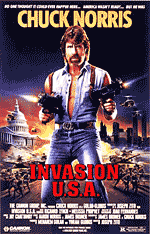
Though it feels like it's been forever, it's still early in the presidential campaign, yet we have what is likely the silliest celebrity campaign endorsement for this election: Chuck Norris has endorsed Mike Huckabee.
Source: "TV Ad: 'Chuck Norris Approved'", 11/19/2007
November 16th, 2007 (Permalink)
Blurb Watch: Mr. Magorium's Wonder Emporium
The new movie Mr. Magorium's Wonder Emporium has received a Metascore of 47 out of 100, which is on the low end of the "Mixed or Average Reviews" category, and a "Rotten" 34% on the Tomatometer. These are both averages of the reviews of movie critics, so the ad writers had to reach into their bag of tricks to find a good blurb. Here's one that they pulled out:
"A Marvelous, Magical Tale!"
Vickie An, Time for Kids
This blurb simultaneously commits the following sins:
- The article quoted is not a review, but an interview with the movie's costar, Natalie Portman.
- The blurb quotes the title rather than the body of the article; in fact, the word "marvelous" does not appear in the body. As I can tell you from personal experience, the title of articles is often supplied by an editor of a publication rather than by the author. So, the ascription of the quote to Vickie An is probably wrong.
- The full title of the article is "A Marvelous, Magical Shop Tale", so the blurb omits the word "shop"―without marking the omission―which changes the meaning of the quote. In the title, the scope of the adjectives "marvelous" and "magical" clearly includes "shop", but not "tale". The title, in other words, says: "a tale of a marvelous, magical shop". It is the shop that is marvelous and magical, rather than the tale.
That's packing a lot of boobytraps into a single blurb!
Sources:
- "Ad for Mr. Magorium's Wonder Emporium", Dallas Morning News, 11/16/2007
- "Mr. Magorium's Wonder Emporium", Metacritic
- "Mr. Magorium's Wonder Emporium", Rotten Tomatoes
- Vickie An, "A Marvelous, Magical Shop Tale", Time for Kids, 11/15/2007
November 9th, 2007 (Permalink)
Q&A
Q: I noticed that you do not show non sequitur as a logical fallacy on your site. Have I missed it or do you consider all formal fallacies as non sequiturs, or do you have a different view on the term "non sequitur"?―Sara Godfrey
A: The term "non sequitur" is Latin and its literal meaning is "it does not follow". However, in English, it is ambiguous, and has at least the following meanings:
- A bad argument: That is, an argument in which the conclusion does not follow from the premisses. Not every bad argument commits some logical fallacy, for instance:
The sky is blue.
Therefore, grass is green.This argument is so bad that it wouldn't fool anyone for a second, but a logical fallacy―at least, as I use the term―is a type of bad argument that can fool at least some of the people some of the time. So, in this sense, "non sequitur" has a wider meaning than "logical fallacy".
- The conclusion of a bad argument: Especially, an obviously irrelevant conclusion.
- An obviously bad argument: Sometimes "non sequitur" is used not just of any old bad argument, but of one that is egregiously bad. Specifically, a non sequitur is an argument in which the premisses are clearly irrelevant to the conclusion. A person commits a non sequitur, in this sense, by suddenly jumping from one subject to another. As indicated under 1, even obviously bad arguments may commit no fallacy.
- An invalid argument: Most fallacious arguments are invalid, but not all―for instance, circular arguments and black-or-white reasoning. Moreover, some invalid arguments are not fallacious―see the example above. So, invalidity and fallaciousness are not co-extensive, nor is the extension of one a subset of the other's. So, in this sense, a "non sequitur" is neither a synonym of "fallacy" nor a type of fallacy.
- Any irrelevance: Sometimes the phrase "non sequitur" is used to describe any sudden jump from one topic to another.
Since there doesn't seem to be any settled meaning of "non sequitur", except for the general one of irrelevance, it might reasonably be used as a synonym for "red herring", that is, the most general fallacy of irrelevance. However, I'm wary of using phrases from Latin, or other dead languages, as names of fallacies or as logical terminology in general. "Red herring" is a familiar phrase, and once you've heard the story of how a pickled herring is used to throw hounds off the scent, the meaning of the term is vividly memorable. For this reason, I seldom use the term "non sequitur", though if I do it's likely to be in sense 3.
Sources:
- Peter A. Angeles, Dictionary of Philosophy (1981). Senses 1 and 5.
- Paul Edwards, The Encyclopedia of Philosophy (1972), Volume 5, p. 64. Sense 4, though the entry is so short that it's difficult to be sure, and it's listed under "fallacy".
- Antony Flew, A Dictionary of Philosophy (Revised Second Edition) (1984). Sense 3.
- Nigel Warburton, Thinking from A to Z (Second Edition) (2001). Sense 2.
November 6th, 2007 (Permalink)
Silly Celebrities
Check out Anne Applebaum on celebrities who like to hobnob with communist dictators.
Source: Anne Applebaum, "The New Fellow-Travelers", Slate, 11/5/2007
- False
- True
- True
- False
- True
- False
- False
- True
- True
- False
Solution to LSAT Logic Puzzle 2: 3.
To solve this puzzle, knowledge of logical fallacies really comes in handy. Alice's argument commits the formal fallacy of Affirming the Consequent, so Bill is right that it's fallacious. However, Bill's own argument is fallacious, since it doesn't follow from the fact that an argument is fallacious that it's conclusion is false―there may well be other arguments for the same conclusion that are cogent. Thus, Bill commits the Fallacy Fallacy.